| SPECIFICATIONS | |
| Denomination | 4½d |
| Alloy | Brass |
| Diameter | 31 mm |
| Thickness | mm |
| Weight | 10.17 gms |
| Shape | Round |
| Edge | Plain |
| DieAxis | O° |
| Issue | |
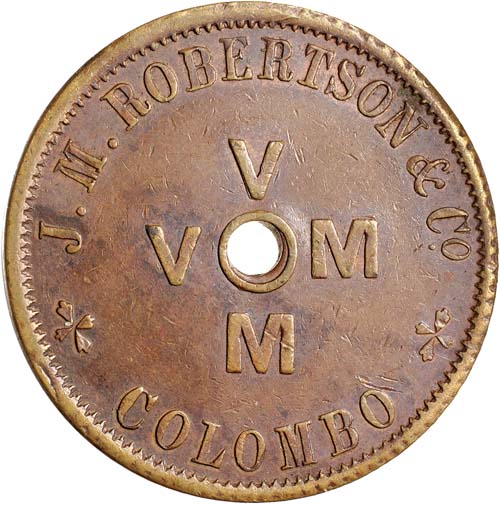
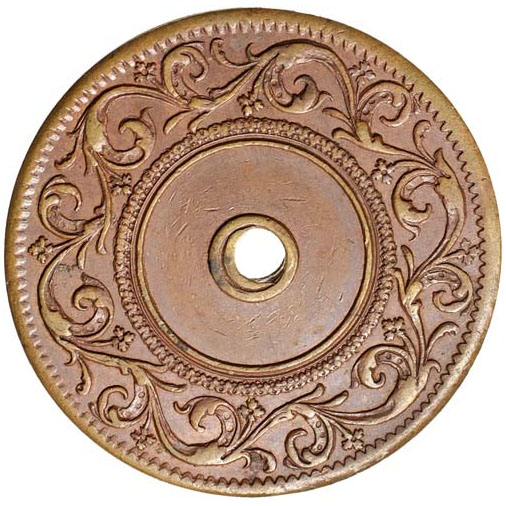
Each token about the size of the bronze penny represented 4½d. or
18¾ cents, being the amount paid at that time for picking
ewt. of clean coffee.
|
|
| ||||||||||||||||||||
| Lowsley #22 Pridmore #82 Mitchiner #2244 | ||||||||||||||||||||||
| Obverse : | J. M. ROBERTSON & Co. -+- COLOMBO -+- | hole bored in centre for suspension, and |
| V V O M M | placed crosswise around the hole. | |
| Reverse : | A broad belt of very elaborate scroll-work between beaded circles. | |
The initials V M around the central hole stand for Vauxhall Mills, which were erected in Vauxhall Street, Slave Island, Colombo.
See also nearby Oil Yard (O Y ) token of similer design.
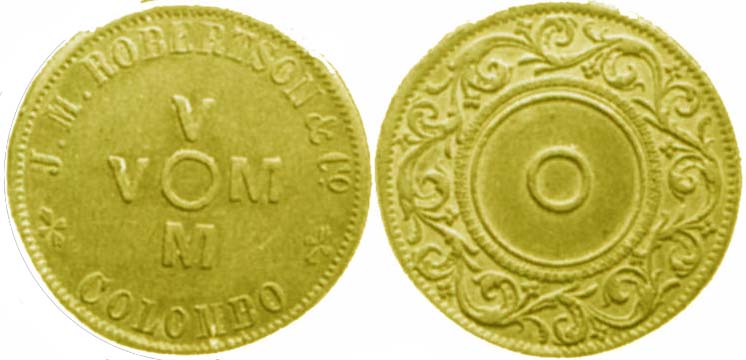 All Robertson's normal tokens were centrally pierced. Pridmore #81 is
a proof or sample speciman of O Y token, with no central hole,
which is in the British Museum.
All Robertson's normal tokens were centrally pierced. Pridmore #81 is
a proof or sample speciman of O Y token, with no central hole,
which is in the British Museum.
Image of a sample speciman of V M token, with no central hole is from B&W print scanned ex Dick Ford Collection (1995 Feb 23 Taisei-Baldwin-Gillio Auction#19 lot #284 part), and colorized with Photo-Shop. It is unlisted in Pridmore.
Messrs. Robertson had the tokens of very similar design supplied
from England by their London agents.
The reasons for the issue of these tokens were the scarcity of
copper coins and the complicated nature of the Ceylon currency at that
period. They went out of circulation as soon as the copper Ceylon
coinage of 1870 was fully established.
ROBERTSON, J. M. & Co. The coffee planting enterprise was at
its zenith in 1845-48, but in 1848 with the introduction of free trade
in Great Britain, the preferential duties of coffee were cut away. At
this time coffee was selling on the London market at about �£ 1 per
cwt. less than the cost of prodnction. Consequently, many estates
became bankrupt.
J. Murray Robertson came to Ceylon to look after the interests of
the Baring Brothers of London who had invested large sums in
Ceylon. On his arrival in Ceylon he established his office in Prince
Street, Colombo, in 1849, and thus founded the firm of J. M. Robertson
& Co.
The business expanded rapidly. The firm had an extensive general
merchant's trade. A large coffee-curing and oil business, for which
purpose they employed a considerable labour force at the Vauxhall
Mills (V.M.), the Oil Yard (O.Y.) near the Vauxhall Mills (Slave
Island), the Wolfenden Mills and the Maligahande Stores.
The Wolfenden Mills, were found to be superfluous and after a
time all the coffee curing was done at the Vauxhall Mills. The Oil
Yard was kept partly for storage purposes, partly for drying coffee,
and later for baling and storing cinchona bark.
The Maligahande Store was used in its later period for storing
manures, etc., till the site was acquired for the purpose of building
the Reservoir which now supplies part of the water requirements of
Colombo.
Reference
* Coins and Tokens
of Ceylon, Lieut. Col B. Lowsley, Num. Chron. Sr III Vol. XV, 1895.
* The Coins of British Commonwealth of Nations to the end of the
reign of George VI 1952
Part 2 - Asian Territories by F. Pridmore Spink & Son Ltd., 1965.
Tokens
* Oriental Coins CE 600 - 1979 by Michael Mitchiner 1979
The coin was scanned at 300dpi and the images are displayed at
200dpi.
The very fine condition coin was obtained from a
collector Chrysantha Goonatelleke in Lanka in 2000, September.