| SPECIFICATIONS | |
| Denomination | 18¾ cents |
| Alloy | Brass |
| Diameter | 29.9 mm |
| Thickness | 1.6 mm |
| Weight | 8.05 gms |
| Shape | Round |
| Edge | grained |
| DieAxis | O° |
| Issue | 500 |
|
|
| ||||||||||||||||||||
| Lowsley #32 Pridmore #22 | ||||||||||||||||||||||
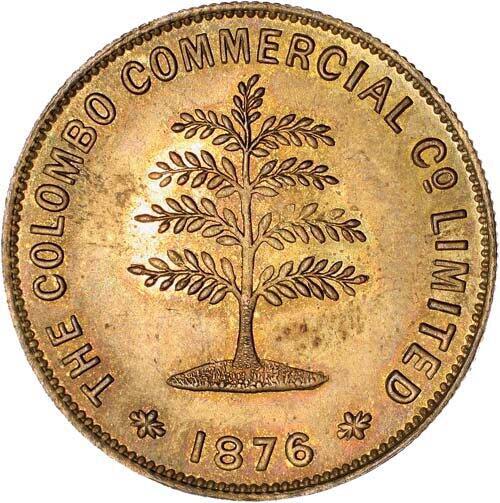
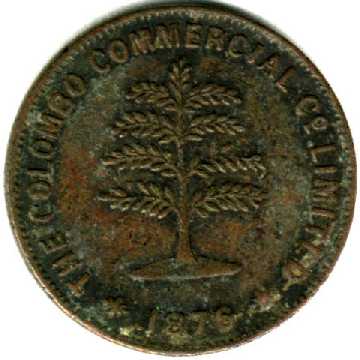
| Obverse : | Centered tea-plant | THE COLOMBO COMMERCIAL CO.LIMITED
* 1876 * | along periphery in beaded circle inside raised rim. |
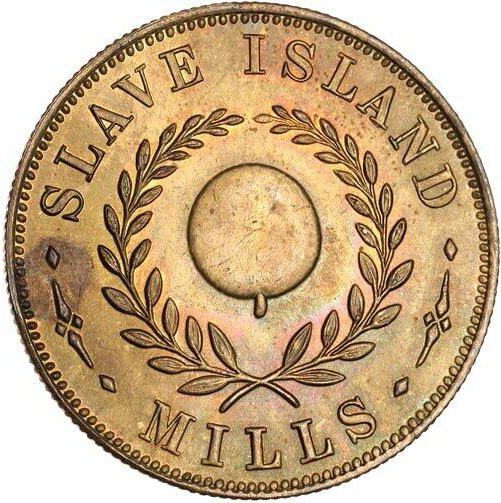
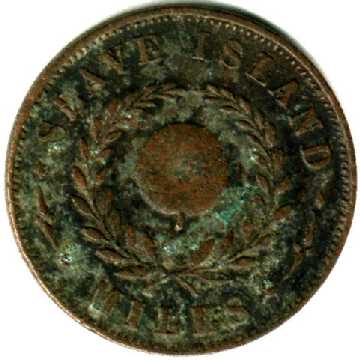
| Reverse : | Centered orange within a Lurel wreath. | SLAVE ISLAND .-:-. MILLS .-:-. | along periphery in beaded circle inside raised rim. |
The Colombo Commercial Company was founded in London and Ceylon by John Burn, an engineer, who was born in Aberdeen. Burn had gained considerable experience since 1848 in coffee planting and in 1876 he opened his own business in Colombo on premises purchased, namely, Acland House and grounds covering l3} acres at Slave Island, which was formerly the mess of the Ceylon Rifle Regiment. During the early years of the Company's progress, the Slave Island Mills handled coffee, tea and artificial manures.
Lowsley records the metal as copper, but Pridmore says that all he examined are struck in Brass. In the cleaned coin above there is a indication of a copper core showing up behind maybe a Brass electro-plate.
Reference
* Coins and Tokens
of Ceylon, Lieut. Col B. Lowsley, Num. Chron. Sr III Vol. XV, 1895.
* The Coins of British Commonwealth of Nations to the end of the
reign of George VI 1952
Part 2 - Asian Territories by F. Pridmore Spink & Son Ltd., 1965.
Tokens
Text has been copied from this webpage into the article on the Colombo Commercial Company in Island Newspaper of 2009 June 21st without any acknowledgement to the source.
| The VF grade token was scanned at 300 dpi and the images are displayed at 200 dpi. It was purchased in 2003 April from a NY-USA dealer as shown on right and cleaned by me to highlight detail. |
|
|